Thursday, 30 July 2009

Day 70 Utila, Honduras

My name is Stewart. I am an Emergency Responder. May I be of assistance?

Jon, our Rescue Diving Instructor, says that's what you say when find someone choking, panicking, bleeding, screaming, unconscious or just simply not breathing. But only after phoning the Emergency Services. And donning a pair of rubber gloves.

Sound silly to you? If so, I'm happy to hear I'm not alone. I just can't bring myself to say it. It seems sooo George Orwells' 1984 and New-speak. You turn up, see person on the floor turning blue and then... Hi! Have a nice day! Would you like fries with that?

Litigation-avoiding daft phrases aside, I'm happy to report that being in Utila has been rather squiffy (smiley face, smiley face).

The 2 or 3 of you reading this blog (God bless your charitable hearts!) will know we arrived in Utila in the dead of night, during a military coup. If not for the kindness of a lady called Louisa, we would have been spending the night sleeping on a dock.

The following morning brought a new day, and a new place to explore. Which - once we had visited the ATM, got our passports stamped and got some brekky - took, in all truth, about thirty minutes.


The island of Utila is not big. The whole landmass is only 14km long. It's sole main street is about 2km long, sandwiched (and I do mean sandwiched) between the sea on one side and a mangrove lagoon on the other. You can walk it in about twenty minutes.


When I say street, I should clarify. I mean single-lane concrete path. Up and down this passageway parade all manner of tourists, locals, tuk-tuks, scooters, trail bikes, quads, rust-masses with wheels and the occasional golf cart. On either side, salt-faded wooden shacks line the place, whilst sun-ripened locals cook, drink and bellow pidgin English at each other, surrounded by hordes of the happiest, healthiest and friendliest dogs known to man. It's lively.

Originally, the Bay Islands (of which Utila is one) were the property of the British Empire. They used them as a launching point for privateering, which is basically posh pirating. They'd drop the Union Jack, sneak up on the Spanish coming back from the new world and bally-well nab their gold for Mother England. Tally ho, hoo-ray and all that tosh! Wot wot.


Eventually, via a diplomatic process I don't fully comprehend, the British agreed to cede control of the islands to the Spanish, in exchange for Belize.


This has left Utila with an interesting ethnic background. The locals are a mixture of native Central Americans, Spaniards, Garifuna (descendants of
Carib, Arawak and African people) and, oddest of all, the descendents of the Scottish and Irish families given the opportunity to settle the island all those years ago. I tell you, there is nothing stranger than hearing someone who clearly looks Celtic let rip with an accent that is 100% Caribbean. It's a spin-out.

There are pretty much only two reasons anyone really comes to Utila. To scuba dive, and to party. The island is in effect the worlds' largest liveaboard, as well as being cheaper than Icelandic Government bonds.


There are a something like twenty dive shops on the island. We chose
Utila Water Sports. They looked good and could qualify us as Advanced Adventure divers under the SSI training qualification. In all truth all the dive shops are much of much, although there are a couple whose encouragement of partying has seem more than a few clients head for the decompression chamber more often than average.

We also bagged ourself a
cool little apartment for a fortnight from a lovely American lady called Maggie. With all the mod cons - kitchen, fridge, TV, aircon, mango tree on the doorstep - it would provide a lovely little oasis of calm after a hard days' diving. Oooooo yeh.

Aaaand off we went. In between dives, we passed hours outside the dive shop chugging beers in the company of some very cool people, two lazy dogs and one psychopathic parrot. Occasionally, we'd take the party outward on onward to one of the many small bars on the island. Be it one of the wharf bars down on the water like Coco Loco (eighties nights and serious partying) or Babalu (open-air aquarium and checkers games)', or something further away from the water like Treetanic (crazy hotel built by complete tripper for tree-house partying) or Bar in the Bush (bar, amazingly enough, situated in the bush with more fights than an Irish wedding).

Alas, with the coup still in force and the President in exile doing the diplomatic equivalent of knock and run (Oh look! I'm back in Honduras! Oh no! I've stepped back across the border again! Ner ner), the only downside to this sprightly little schedule was the 12pm curfew.

Still, no matter. The benefit of Utila's diving scene is it gives everyone a focus; something everyone needs to get up for. It also helps you forge friendships quickly. We met some very cool people, meaning curfew time simply meant changing venues to someone's home, followed by a late-night dash home, avoiding the police patrol (although, in honesty, I'm not sure they were anywhere but home in bed).

So, the first two weeks rolled along nicely. We got to know Vicki and Lee very well indeed. They told us how they had arrived in Utila for a short holiday, completely scared of water, before staying four months to become Dive Masters. We enjoyed the company of Kiwi lad Terry and his Dutch girlfriend Sebine (from Rachels' Dads' home town of Nijmegen no less!). We warmed to the shops' silent but strong Swiss superman, Ramun, and his 70m+ depth diving feats. The company of the aussiest of Aussie brothers Shane and Craig was similarly a damned pleasant way to waste an hour or four over a Baleada (awesome food!) and a rum.

Then, one balmy morning, Rachel proposed what had been bouncing around her visually-pleasant bonce for a week or so. "Let's become Rescue Divers," proposed the raven-haired beauty.

"Great idea," I responded. After all, if one doesn't come back from life-changing year long travels with a whole bunch of brand new "mad" skills, well, it's just not cricket, is it?


The thing is; becoming a Rescue Diver ain't easy. Especially when your instructor, Jon, takes great pride in his course. Great pride in the sense that rather than teaching you the course one way, or the other way; instead he teaches you everything you could possibly need to know. His approach was like teaching someone to bake a cake by first beginning with the molecular composition of flour.

It was tough. We studied long hours. We spent hours at sea pulling "unconscious" divers up from the depths, or trying to get someone onto boat against current. Rachel accidentally locked smackers with Terry once whilst simulating CPR on the boat. (Note: real corpses don't piss themselves laughing, Terry).

In the end, we did it. Sixteen days, seventeen dives, countless beers and more
baleadas than you can fit in a Mini cooper, we boarded the Utila Princess (don't be fooled by the name. It's a box on a boat) happy in the knowledge that if we ever see someone drowning, Rachel will most likely end up snogging them.

It's almost worth it...


For all dem photo fer Utila, click here, mon

Sunday, 12 July 2009

Day 63 - Livingston (Guatemala) to Utila (Honduras) in a pea green boat

“The best laid schemes of mice and men/ Go often askew,” wrote Scots poet Robert Burns in 1785 (or “Gang aft agley” for the purist Scots out there). He may not have been talking about traveling, but in this case the wisdom fits perfectly

You see, the good thing about having a plan, is having the option of abandoning it at a moments' notice. Because (as Universal Truth #2 will attest to), the best adventures are usually borne of last-minute decisions.


And so came about the sequence of events that led to us being sat in the middle of the Caribbean Ocean, paying passengers on the 35ft yacht of a rather silent and
very strange Frenchman.

Everything big begins small (see the post “Feather, Brick, Truck”). This latest adventure began quite innocuously, in a motel room in the Mexican border town of Chetumal.

The latest plan was to head to the Belizean island of Caye Caulker for some scuba diving. Our original route, via Honduras, had been abandoned due to the distance and time needed to get there. You simply can't do everything in two months now, can you? Instead, we would take the opportunity to take more time soaking up the beauty of Southern Guatemala.

That was until we walked home from dinner and had a conversation that went something like this;

Stewart: Right. Up early tomorrow. Head for the border, then we can get a fast boat direct from Corozal to Caye Caulker. We should be there by lunch.
Rachel: Great. It's a shame we're missing Honduras though. The diving is sooo cheap there.
Stewart: Yeh. I'm gutted to miss out on the Crystal Maiden in San Ignacio too.
Rachel: Me too. Bummer, eh?
Stewart: Maybe we should go there after all?
Rachel: Maybe we should.
Stewart: Settled then! Let's go to Honduras via San Ignacio!

And there you have it. Proof that sometimes the right decision is the one that is easiest to make.

That's not to say it's always the easiest to do though...

Two days after embarking on our spontaneous little detour, a friendly New Yorker called Norm informed us of the fact that Honduras had just undergone a military coup. The borders were closed indefinitely. Still, something told us we should keep going.

In Rio Dulce, three days later, we heard about a travel company that offered a sailboat service direct from Guatemala to the Bay Islands. But first we needed to take a two hour ride up the river to the coast, to a small town called Livingston.

Livingston is only accessible by small boat. The journey involves crossing Guatemala's second largest lake, Lago de Isabel, before traveling through a series of gorges up to 100m tall. According to the Rough Guide to Central America, the town “offers a unique fusion of Guatemalan and Caribbean culture in which marimba mixes with Marley”.

Personally, I didn't see it. If garbage everywhere, stray dogs following you home and “sandflies” that eat you alive are your idea of Caribbean culture, then I stand corrected. Despite enjoying two days at a very lively hostel (Casa de la Iguana) run by an amicable, former stripper called Rusty, we were pretty much ready to high-tail it out of there asap.

The news from Honduras was good. The borders were open and, despite the president still being in exile, we were told that passage was possible. With the intention of by-passing the mainland, the trouble and numerous roadblocks, five of us met with the fabled Capitan Eric to negotiate passage.

We'd met Josh and Te when they checked into our swamp in Rio Dulce. Former partners from the US, they'd decided that breaking up shouldn't stand in the way of the round the world trip they'd planned. Brave people. Elyse, a blond beach chick from Manly, was doing a fine job of spreading the world reputation of Aussie chicks for being bubbly-as-champagne, willing to call-a-spade-a-spade and up for anything.

Which is more than can be said for Le Capitan. Monosyllabic at best, we were truly in the presence of someone accustomed to spending days alone at sea. At first I assumed his lack of conversation was due to the language barrier. However, he proved to be equally uninterested in small talk in both French and Spanish. He seemed to prefer chain-smoking Marlboro Lights, downing rum like water and fasting (we never saw him eat the entire time we were in his company). Still, we had a boat and in two short days we'd be happily tucking into fresh lobster and planning all manner of dive trips.

Alas, sailing the Caribbean wasn't quite the pleasure trip you'd imagine. Eric's boat was more functional than fabulous, and the trade winds and currents in this part of the world travel from East to West. That left us traveling against the tide. And the swell. Poor Rachel, Te and particularly Josh spent most of the first day with their heads over the side, feeding the fish.

Another day sailing against the wind (less Te and Josh who'd decided that another day of seasickness wasn't for them, and taken a bus), watching Le Capitan plough his way through cigarettes and rum, and we'd arrived.

Alas, we'd arrived five hours late, at 1am rather than 7pm. The military-imposed curfew of 11pm meant the streets were deserted. It had been two days since we had showered. We were covered in salt and sun cream. We smelled bad and felt worse. Sleeping on the dock (or, god forbid, another night in Le Capitan's boat) wasn't doing it for us.

In these situations you really do rely on fate, and the kindness of strangers. An hour spent ducking between closed hotels and I was lucky enough to find the only hotelier on the island still awake. Thirty minutes later, showered and clean, we were all sound asleep in our beds.

Don't you love it when a plan comes together?


For all the pictures from Livingston and our journey to paradise, click here

Monday, 6 July 2009

Day 56 - Deep in the swamps of Rio Dulce

We're deep in the jungle now. Insects I have never seen before, big insects, are everywhere. Hidden birds let rip with weird and wonderful squeaks and warbles, whilst the cicadas never stop. The smell of swamp and mangroves is all around, but not as offensive as you would think. I turn to Rachel and tell her it reminds me of the computer game, The Secret of Monkey Island. She laughs and agrees. We sing the theme tune, talk about geeky things for a bit and laugh some more.

It's fun being in a swamp. Our cabin is made of wood planks and has netting for windows. Boardwalks run between all the buildings. At night, they light candles and oil lamps, giving it all a middle-of-nowhere, voodoo feel. I feel like I am holed-up in a secret pirate lair. Any minute now, I expect Johnny Depp to walk into the bar in mascara and order rum.

After crossing the border into Guatemala, we spent two nights in Flores. It's a cobbledy little island-town in the middle of a lake. It was pretty enough. The hostel we stayed in (Los Amigos) was full of animals and characters. A parrot, four quail, three dogs, a cat, two amicable Irishman, a Sharon Stone-esque Aussie chick called Thea and a whole bunch of 'crayshy' Dutchmen.

We were up early the day after we arrived to visit Tikal. It's the largest classical city of the Mayan civilisation. It's big. Huge in fact. People told us it was big, but until you get there, you don't realise how big. Imagine the list of debtors for the Michael Jackson estate, double it, and you're beginning to get there.

We hired a guide called Donald. We had him all to ourselves. He took us all around the site, telling us about the history and pointing out various fauna and flora. We climbed the vertiginous temples. He showed us bush herbs. We saw monkeys. The sign said they sometimes throw poo at you, but they seemed more interested in swinging about a bit.

But that was two days ago. Now, we're holed up here in our swamp, near the banks of the Rio Dulce. We're here with an amazingly cool American couple – Bryce and Laura – and an adventurous Dutch girl called Frankie. There was a group of Isrealis, but they left early, complaining of mosquitos. What do you expect in a swamp?

Last night, Bryce, Frankie and me crashed a party at another house across the swamp. The three of us got there in our two-man dinghy. We played lots of drinking games and drank lots of rum. I´m not quite sure how we got back again, but come the morning I was back in my bed. Obviously beer scooters still work in swamps.

It's hot. Guatemala is hot. Clothes seem to serve the purpose of soaking up sweat here. If ever there was a country where national nudism would make sense, it's Guatemala. That were if it weren't for the insects. They like to bite exposed flesh.

The entertainment options here in our swamp are:

1. Read
2. Write

3. Play 'Sally's Spa' on your iPod (Rachel only activity)

4. Eat

5. Sleep

6. Kayak out into the lake and swim

7. Drink rum

There is no internet, no TV and no radio. Just the swamp and us.

There is a bartender. He is a Swiss man and he owns the place. He doesn't talk much. Sometimes I catch him staring into space, not moving. Maybe it's the swamp doing strange things to his mind.

The malaria tablets are giving me strange dreams. A few nights ago, I dreamt about Nicky Hilton's house under a shopping mall, an incredible airport atop a mountain in Scotland called Chlorine (the only airport in the world where you gain altitude to land) and Bruce Willis' wife making a big social faux pas in front of George Bush's (black) daughters at Prince Harry's garden party. Who needs TV?

Meanwhile, we wait in our swamp. We are waiting for the border with Honduras to open. A week ago the military staged a peaceful coup, ejecting the President. Everybody seems to have got quite upset about it, so the end result is we can't cross the border until they sort it out. The lady at the travel agent in Livingston (a town only accessible by boat) seems to think it'll take 72 hours. Once that's done, we'll head to the Bay Islands by boat to do some diving.

Until then, it's just us, the insects and the swamp.

Luckily, we've lots of rum.

Aaaar.


PS. Rachel doesn't think it's a swamp. She says it's mangroves, in a rainforest. Personally, I prefer to call it a swamp. It sounds more piratey.

For a whole host more swampy pics, plus some ones of a waterfall we visited and some other places, click here


Day 52 – (200m underneath a mountain near) San Ignacio

The cave swallowed us whole about two hours ago. Swimming through the entrance, the water coming from deep within the mountain took my breath away. But in the humidity of the Belizean jungle, it was a welcome respite.

It rained heavily last night. The fury of the tropical storm lasted only twenty minutes, but it was intense. Three lightning strikes a stone-throw from the restaurant made us jump as we ate. Luckily, we didn't choose the soup. It turned the main street of San Ignacio to mush (the rain, not the soup).

That night before has turned the cave known as Actun Tunichil Muknal (the 'Cave of the Stone Sepulchre', or 'ATM cave' for short) into an underground river. We wade along the path; sometimes the water is ankle deep, sometimes it comes up to our chests. Other times we can't even feel the ground beneath our feet. Our splashes echo back at us from the inky blackness ahead and behind. There is no light our eyes can use to acclimatise. Without torches, we would surely never get back to daylight.

Martin is our guide. He assures me he has spare batteries. He's like a little Mayan Yoda, weaving a story to accompany our journey. He knows a lot about the Maya. They were religious people, says Martin. They worshiped elemental gods with a fervour that makes the Hillsong congregation look like part-time atheists.

The Maya believed that sacrifices of food and animals would secure them, in return, all they needed to flourish. They believed the gods would provide all they needed to build and maintain their giant cities; far bigger than any in Europe at that time.

We squeeze through another small crevice in the rock wall, and another chamber opens up ahead. Giant stalactite formations hang from above, reaching down to grasp their stalagmite brethren. In thousands of years, perhaps they will finally join hands.

We climb up another ledge, out of the water. Removing our shoes, we tiptoe carefully into a new chamber. Torchlight dances on the walls all around, throwing shapes. Sometimes, you catch a figure dancing in your periphery, or a large animal darting behind a rock. But it's all in your mind.

Martin says the Maya believed that the gods resided in the underworld. They came to this cave – the link between the two worlds – to worship. I imagine how the shadows on the walls would have looked to the Mayan priests, high on natural psychedelics. No wonder they believed the gods lived here.

They brought with them great pots, and prepared meals as offerings. Martin points out the wrecked pottery scattered all around, everywhere, unmoved since the day they were carried in here, a thousand years in the past.

My mind wanders again. I remember Rachel meeting Martin the night before, in a little bar called Orleanitos, just off the square in San Ignacio. We all talked for hours over Jambalaya and rum, listening to the Caribbean lilt of everyone's voices. It feels good to speak English again, Belize's legacy of a British colonial past. They were so friendly, like everyone in this tiny little town. A speck on the map before the border with Guatemala, but oh so inviting. Infectious.


Speaking with the locals and expats, they all say the same thing. San Ignacio is a place where everyone knows everyone. Where everyone takes care of everyone. A place where you go for a haircut, and end up playing football that afternoon with Floyd the barber. Where people you met the day before beep you and wave when they drive past on the street. Where even the drunks stop for a friendly chat. Surrounded by rainforest and fast-flowing rivers, it's a little oasis of Caribbean calm high in the mountains. I can imagine getting stuck here for a while.

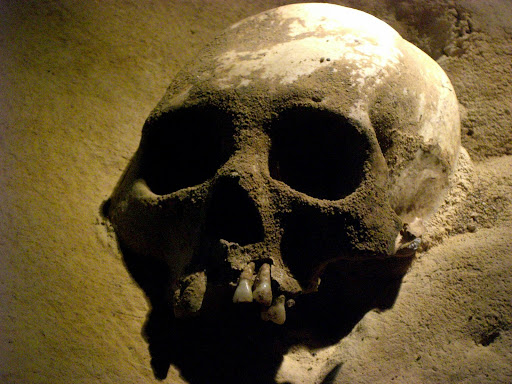
Martin is speaking again. Martin tells us as the drought became more pronounced, the Maya became more desperate. The gods had forsaken them. They began to up the stakes. Human sacrifice. He points out a skull on the floor. It's forehead is flattened, done when the noble child was a baby. A hole in it's head shows the killing blow. Martin says there are fourteen such sacrifices in this cave. Seven of them are children.

Nobody knows where the lowland Maya went. They abandoned their cities, their places of worship. Some believe their society fell because of prolonged drought, others due to peasant revolution. Maybe, in seeking the favour of the gods, the full horror of what their society had become, what they had began to do, became apparent. Maybe many Maya simply rejected the deeds their spiritual leaders had begun committing in their name, and left for the hills and a more primitive life.

Now, Martin is telling the story of a young girl; maybe 14, maybe 20. I can't hear exactly. She was an important person, maybe the daughter of a rival city leader, captured during war. She would have been brought down into this cave, probably blindfolded or drugged, knowing her fate.

She would have been ritually killed. An axe to the base of the spine, then another to the head. Another desperate blood offering to the non-responsive Maya gods.

Then Martin shines his torch and there she lies. Her tiny skeleton is splayed out on the floor. Martin explains she was an offering to the rain god, Chaac. Her position is deliberate. As the cave filled with rainwater, her body lay in a shallow pool. She would have looked like she was dancing; a rain dance.

The years in the cave have covered her skeleton with a thin layer of limestone, keeping her safe from decay until the day she was found in 1986. The limestone shimmers in the light. Her entire skeleton looks like it is encrusted with tiny diamonds.

Nobody knows who she was, where she came from. Nobody will ever know her name, or the full horrors she experienced deep within this cave. However, as if for some small recompense, in death nature has gifted her with a beauty that has lasted through the ages. She is the Crystal Maiden, and this is her cave.

View all the St Ignacio photos here

Day 48 – On the run and headed for the border

Dead dog lying on the side of road, flies partying all around. The border is an hour behind us now. Sticky heat of Belize building, adding to my paranoia. My head is bumping like a road-drill. Dirty, cheap rum poisoning my system. The bus jumps again, riding the “road” like a rubber ball on cobblestones. Brain rattles in my skull, turning my thoughts to mush.

Today is a bad day to give up smoking.

Again, I catch a car behind us. White and gaining fast. Through steamed-up glasses and dirt-smeared bus windows, It looks like the police. Heart jumps again, electricity coursing through my arms. I begin to sweat again. Brain begins to work overtime. Images fly through my brain.

Me being gunned down on the bus. Me being gunned down getting off the bus. Me in the back of the trunk, arms tied down to cramping. Me disappearing into the depths of a Mexican prison. Then, the face of Groovy John disappearing under the water.

Goddamn this heat.

At the border, the heavyset Mexican customs man waved me through without a fuss. I smelled a trap. Standing at the Belizean counter, ten metres away, I kept him in my peripheral, waiting to be jumped from behind. The butt of my gun felt heavy on my thigh, a welcome friend at a troubled time. Just try to stop me! No, no, no. I need to be cool. Be like Fonzie. Eyyyy.

The Belizean man stamped my passport, waved me through. I hurried through the door and onto the first bus I could find. Nobody followed. Are they screwing with me? Waiting for me to relax? I sat at the back, next to the emergency exit.

Groovy John's dying face burns in my vision like a cattle brand. The waters recede and he sinks. Maggot food.

The car is getting closer. I feel for my silver friend. The steel is cool against the maddening heat. I flick the safety. Check for the briefcase under the seat.

Raquel can see my fury. My fear. She knows the trouble we are in. She smiles warmly, but I know she is as scared as me. I squeeze her hand. We go together.

Yesterday, we frolicked in the lakeside. The only guests in an empty hotel. We dived and jumped and splashed. The cool water making us forget ourselves for a moment. We had forever ahead of us. Now so short. Cruel irony.

The car is close now. They are nearly on us. My heart pounds against my ribs. Time for action. Death whispers sweet nothings in my ear, taunting. I go to stand.

The car passes in a cloud of dust. No sirens, no lights, no badges on the side. False alarm again. My heart does a jig of joy. The wet rivers of sweat down my back begin to slowly dry. False alarm.

I sit and breath deeply. Just three hours 'til San Ignacio. We'll know what to do when we get there. Everything will be better there.

The vision of Groovy John still burns like neon in my mind. But he's gone now. He's not here. And here is all that matters now.

Goddamn this heat.


Please note: this is a work of fiction. The trip across the border was mostly uneventful. We are not on the run. I do not have a gun. Rachel has not changed her name to Raquel. We have not killed anyone called Groovy John. I don't even know if there is such a person called Groovy John (it is a cool name though). In fact, we haven't killed anyone (yet). Call off the search party. Thank you for listening. Stay tuned for more adventures after this break.

Day 42 – Tulum

Back when I was a kid, we used to take Geography classes. Radical new wave teaching, I know, but bear with me. Occasionally, the teacher used to touch briefly on something called “The Greenhouse Effect”. This was cutting edge stuff. He talked about “renewable energy”, “acid rain” and polystyrene cups that didn't contain CFCs. Outside of school though, you only only heard this kind of stuff from dirty, white men with dreads and bra-less women with piercings.

Nowadays, green issues are not just big news, they are also big business. And leisure is no exception to that rule.

We made the decision to leave Playa on Sunday night. It'd been fun, but I'd had my fill of 60 peso Margharitas, cruise ships and souvenir stand owners trying to sell me weed. So we jumped on a bus and headed for Tulum.

Tulum holds the distinction of being the only place in Mexico where you can visit Mayan ruins on the beach. Type 'Tulum' into Google Images. You'll find images of a pale, grey limestone pyramid, framed by palm trees and the turquiose waters of the Carribean Sea. It's picturesque.

Tulum is also famous for cenotes. Cenotes are deep, freshwater holes in the ground. You see, the Yucatan peninsula is basically swiss cheese. When the limestone rose from the sea million years ago, vast networks of underground rivers were created by the retreating waters. As a result, the entire region is dotted with over 5,000 freshwater pools, themselves gateways to sunken caverns that flow for miles and miles. Which you can go diving in. Which we did.

I cannot speak highly enough about it. In all honesty, the prospect of cave diving was something I wasn't sure how to feel about. I'm always one for big fish, and you don't get much life in a cave system. The Pocket Rocket wasn't too sure about it all either, Even less so when we arrived at the dive site in a vehicle best described as the outline of a truck. You see, the entrance to our dive site was basically a hole in the ground only slightly wider than ourselves.

However, as soon as we climbed down the ladder, all doubts evaporated. It became clear why the Mayas considered these 'magical' cenotes to be the lifeblood of their empire. To step into a cenote cave is to drop into a world a good 4-5 degrees cooler than the stifling humidity of the surface. Clear, clear water casts ever shifting light patterns on the stalacmites that drop down from the ceiling. It's a serene place.

We did two dives that day, descending down into a network of sunken caverns and passageways piled on top of each other and filled with all kinds of weird and wonderful shapes and structures. Sometimes we would shine out torches into the gloom, watching the way the shadows would play out against the rock walls. Occasionally, we shut out the lights and hung motionless in the gloom, watching weak shards of distant daylight filter in from above.

Occasionally, we shone our torches into the darkness of bottomless tunnels. One particularly ominous one began with a warning sign embossed with the figure of the Grim Reaper. This particular tunnel had claimed the life of 300 divers. Even pottering around well-explored cenotes like Dos Ojos, it was easy to lose track of where you were, where you'd come from. It's a enticingly deadly world, and a fragile one that I hope will last the test of time and tourism.

Which brings me back nicely to my first point. Where Cancun and Playa are shrines to excess and consumption, Tulum advertises itself as the cutting edge of eco-tourism. However, this is where I tend to get a little cynical.

Which comes first? Deciding to be an eco-resort and making wholesale changes to the way you run your operation; or realising you have a hotel with no electricity or fresh running water, so calling yourself and eco-resort and charging top dollar for the “rustic experience”.

There is something undeniably romantic about the idea of being in a wooden cabana by the shore of the Carribean Sea. All you have is the bright night sky and candlelight for company.

The reality is it's romantic for about ten minutes. After that, spending twenty minutes trying to find your toothbrush in the half-light, trying to sleep in the oppressive humidity and getting eaten alive by mozzies make it hard to see this expensive primitivism as nothing more than a bit of a crock. Oh yeah, and there was an old, naked guy on the clothing-optional beach who insisted on walking around every ten minutes so we could all see his wrinkly, brown bits. Why are 90% of nudists fat, old guys?

Tulum is a lovely place. Gorgeous beach, great ruins and superb diving. In reality though, it's just as touristy as Playa. Luxury backpacking for grown-ups, minus the luxury and the backpackers.

Thursday, 25 June 2009

Day 43 - Playa del Carmen

Chuck, the large fat man from Tennessee, is in the middle of telling his equally fat daughter all about the proud history of WWE wrestling – from across the other side of the beach. Chucks' equally fat, tooth-lacking wife is letting everyone within a nautical mile know that 'a couple more o' dem Margaretas' and 'she gonna git nekkid'. The Mexican reggae band in the back of the bar is launching into yet another version of Bob Marley's 'Don Juarry'. The guy in the souvenir stand (monkey heads carved from coconuts, sombreros, fake Cuban cigars etc) has just tried to sell me weed. In a few hours, I'll witness a woman who truly believes that you can make yourself understood in any language simply by speaking as loudly as possible. Today, clearly, is the day the cruise liners visit.

Playa del Carmen seems to be to Americans what Mallorca is to the English, or Bali is to the Australians. Like it's bolder, brasher cousin one hour north, Cancun, it's serves the purpose of liberating American dollars from American pockets.

Our first glimpse upon arriving late M
onday night was the road known as La Quinta, or Fifth Street. It's an indeterminate length of road, lined with the aforementioned souvenir shops (surely a front?), quasi-designer clothing & accessory boutiques, pharmacies, novelty theme restaurants & fast food joints, and tour companies. It's all about as Mexican as sour cream on your nachos.

But then you carry on walking a little further, away from the sunburnt tourists ambling aimlessly up and down the strip, and you find the beach.

And what a beach is it!


For five days, we've simply marvelled at the way the water changes colour during the day. From a calm aquamarine blue in the morning, to a cloudy crystalline azul before dusk. It's always like stepping into the perfect backyard pool. Cool enough to steal you away from the maddening heat of the town, but warm enough to leave your breath in your chest.

Did I mention the bars and clubs? Big, sprawling, multi-level temples of music, spilling out onto the white sand and filled with fire twirlers, sand floors, bar-swings rather than bar-stools and more thatch than 1980s Britain. Beach as bro.
Here, see for yourself.

Add to the mix sand so soft you could sift it through gauze, and you've got a recipe for lazin'. Which is pretty much what we've done. The first day we headed to the supermarket for a couple of fat steaks and a nice bottle of Tanqueray. After we'd polished that off, we made the short twenty metre trip to dive into the water.


On Day 3, we decided twenty metres was a little too far. So we moved into the place across the road, which was only ten metres and had a better view.

Yep, a good beach will forgive a lot.

All the Playa photos are here

Day 36 - Oaxaca

In 1519, a ruthless Spanish military leader named Hernan Cortes landed on the North East coast of modern Mexico with a big, hairy, audacious goal. He sought conquest of the 'New World' and to claim her gold for Spain. This latter-day Goldmember brought with him 550 men (well, Spaniards), horses, attack dogs and 1 cannon. His first act was to burn all the expeditions' ships. Clearly this pale, bearded Spaniard was no Len Shackleton.

At the time of his arrival, the population of Europe was 6 million. The total population of the lands he sought to conquer was over 25 million.

Despite the enormity of the task facing him, Cortes had three distinct advantages. The first was guns. The native tribes lived in a land plentiful in gold, but lacking steel. Their warriors fought only with spears and slings.


The second advantage was germs. The Spanish brought with them, flowing through their veins, all manner of virulent strains of European disease. These were diseases unknown to the New World, and they would wipe out an estimated 80% of the native population in the years to come.

The third, and perhaps most telling of all advantages, was Cortes himself. Moctezuma - the Emperor of the most powerful of the New World empires, the Aztecs – was a superstitious man. 1519 also happened to be the predicted date for the return of the god Quetzalcoatl, who scripture described as a pale, bearded figure (the Incas themselves were mostly hairless).


And so unfolded historys' greatest 'Sliding Doors' moment. Right place, right time (or wrong place, wrong time if you happened to be a native).

When Moctezuma was told that a pale, bearded figure, supported by legions of unknown creatures, had landed that fateful day, he chose not to send a legion to destroy them as they put feet on dry land. He did not ambush them whilst they slept their first, new night in the deep jungle. Instead, he sent an envoy to invite them to join him in his palace.


It was to be the mistake that defined the future of a continent. Cortes, as ruthless as ever, took the emperor hostage. Over the years that followed, he subjugated an entire continent, by sword, alliance and sheer will. He converted most to Catholicism. He enslaved those who failed to support him. He rewrote the history books, building Spanish churches atop existing native temples and ziggurats. All the gold the New World possessed became his. His role in history today is defined by his actions; the Conquistador.

The overriding flavor of Oaxaca (Wa-ha-ka) is history. History and food. We arrived here in the early morning, following a long, smelly, six-hour,overnight bus trip down from Mexico City. In the dawn light, the town looked like something from a spaghetti western. Lots of whitewashed, plastered walls fallen into disrepair and crumbling all around. The only thing which spoilt the image were the lush green mountains encircling the town.

A walk exposed the 'town' for what it really is, a city. Oaxaca the city is, fittingly, the capital of Oaxaca the region. It's a picture postcard place, a thin veneer of history covering what is a fairly modern city. It's very low-rise too. There are few buildings, if any, greater than two stories.

It's known throughout Mexico for it's culinary standing. Dishes such a dark, chocolaty mole, a light string cheese called quesillo, tequila-esque firewater mezcal and salted, lime crickets called chapulines are all celeberated as Oaxacan staples. In fact, you can't walk around a corner without spotting some small restaurant nestled in an inner courtyard, or up atop of a roof. It's a foodies dream and, for the record, the crickets simply taste salty.

After the 24/7 spin cycle of Mexico City, Oaxaca has been an opportunity to take it down a notch. We've wandered down her streets, marvelled at grand old stand-stone buildings and sauntered through the markets for which the city is also known. We took a particularly memorable, long, dusty trip into the mountains to an amazing place called Hierve el Agua. It's basically the site of hot (read, tepid) springs, where you can sit in a mineral-rich pool on the edge of a cliff and survey the valleys below. What makes it especially amazing is seeing where the calcium-rich waters have flowed down the rock, leaving an eerie, white ghost of a waterfall suspended motionless for eternity.

However, at the risk of continuing the history lesson and boring everyone, it's hard not to be in Oaxaca and soak up the past. It's everywhere. It's in the faces of the people, the food that comes across your table, the museums all around town and, most of all, the buildings.

In ancient times, the land around Oaxaca gave rise to one of the most potent empires of the time. The Zapotecas rose to prominence in 500AD. Later, they built their impressive capital, Monte Alban. This city, which ruled over the surrounding villages for over 1300 years before mysteriously being abandoned, is an amazing place. High on a hilltop, it truly shudders the mind to conceive of the effort that went into building the city, especially when you realise they sheered the top off a mountain to do it.

It makes your realise that for all our technology, our modern day smarts, maybe we're not as clever as we think (especially given recent economic events). After all, when was the last time you heard of a group of people clearing an entire mountaintop using only basic tools, before building a city that would endure for over 1300 years? It puts those of us who struggle to assemble Ikea furniture to shame.

You'll be happy to know the Spanish is coming on nicely, with only three glaring oversights. Rachel managed to wander around for most of our night out in Mexico City telling the many Mexican men she was chatting with I was her hermano (brother) rather than esposo (husband). It made for some odd faces when I gave her a kiss a bit later in the evening. Walking down the road in Oaxaca she rather abruptly told an old man selling native artwork no me gusta (I don't like it), rather than the more polite no quiero (I don't want it). However, the guff of the month probably goes to me for telling a chambermaid this pillow is my wife, rather than this pillow is my wife's.


Still, would have made for an interesting wedding.

All the Oaxaca snaps son aqui

Sunday, 14 June 2009

Day 30 - Mexico City

The scene: A small movie producers' office in Hollywood. The decor is old and worn, and wallpaper is peeling from the walls. A window is open and a hot wind occasionally blows the thin curtain inside the room. A man is sat at a desk. His name is Stan and he is a movie producer. Soon, a second man joins him, sitting opposite him. His name is Laurie. He is a writer. They begin to talk.

Laurie:
I have an idea for a movie!
Stan
(looking up from his desk): Great! It's been a while Laurie. I was beginning to worry. You wanna coffee?
Laurie:
No, I had one at Starbucks on the way.
Stan (pressing the intercom): Candy, get me a coffee, will ya. Now Laurie, tell me all about it.
Laurie: Well, it's set in Mexico City....
Stan
(interrupting): Mexico City! Mexico City? Seriously, who sets a movie in Mexico City?
Laurie: Have you ever been?
Stan: Well, no. It's far too dangerous. Aren't there drug wars there? And what about that pig flu?
Laurie:
No, no, you've got it all wrong. Mexico City is massively underrated. It's an amazing place.
Stan: Sure, but for a movie?
Laurie:
Yeh! Sure! It's got more history than it knows what to do with. The place is an amazing historical city. It's completely unique, like no other city. And the people are some of the most friendly you'll ever meet in a city of 20 million plus. As far as dangerous goes, sure if you go walking into the wrong area of town at 3am you're in trouble. Other than that, it's no more dangerous than any other big city, I tells ya! As for swine flu, I've never heard such a bunch of hot air...
Stan:
Really? But the newspapers...
Laurie: Forget the papers. Swine flu has been blown out of all proportion, and Mexico City is the right place to shoot this film. If you can handle a little pollution, it's got everything a film crew will need. Great food, superb locations and the best bit Laurie? It's cheap!
Laurie: That I like, Stan! So what's the film about?
Stan: Well, it's about people, really. It's about a moment in life when the chemistry between a group of strangers is simply perfect, and something unique comes along for one brilliant minute. It burns brightly and then, just as quickly as it came, it's gone.
Laurie
: Break it down for me Stan.
Stan
: It's about a group of travellers who come together at a hostel in...
Laurie: ...Mexico City...
Stan: ...right, and for four brilliant days, everything just clicks.
Laurie: Clicks?
Stan: Yeh, you know. The mix of people is right. The setting is right. Everything just works and what results is...
Laurie: A Hollywood blockbuster!
Stan: Maybe, Laurie. This film is not just about wandering around one of the biggest cities in the world, taking in the sites. It's not just about seeing the Zocalo, or learning the history of a city that is over 500 years old. It's not just about partying into the wee hours of the morning, or enjoying a beer on a rooftop overlooking the Cathedral. It's also about great conversation, and living for the moment with a group of people that have never met before – and may never again - but in the here and now, manage to strike up a vibe between themselves.
Laurie: Who are we talking about here?
Stan: I'm glad you asked. Let me tell you about the characters.
Laurie: Great! Good characters sell!
Stan: And these are real people, Laurie! First we have Gerry.
Laurie: Gerry?
Stan: Well, Gerraldo actually. He's a pivotal character in the whole story. He's a bartender by day and runs the entertainment at the hostel. Gerraldo is the single most connected man you'll ever meet in your life. He's always got a smile on his face and has more energy than a supernova. He's a little Mexican energizer bunny. Seriously Laurie, the audience won't be able to help themselves but love him!
Laurie: I like him already! Hey! Why not give him a partner in crime?
Stan: I'm already ahead of you, Laurie. I've given him a partner in crime alright. One of the most unexpected ones you can imagine!
Laurie: Stan, you're turning me on.
Stan: Steady Laurie. Meet Viktor! He's a baby faced Swede...
Laurie: Not a Dane?
Stan: No, Swede. He's a baby-faced, 23 year old Swede with a quirky sense of humour and dead pan delivery that the audience will never see coming. He's a one-man show wrapped in a Legend and pumped full of funny-juice. Put him with Gerraldo and watch the sparks fly!
Laurie: Whoops, Stan. I nearly just fell of my chair.
Stan: Next, we've got a loud, opinionated, brash American...
Laurie: Hmmm. I'm not sure on that, Stan. L.O.B Americans haven't tested well since Tom Arnold divorced Rosanne.
Stan
: I hear ya, Laurie, but there's a twist.
Laurie
: A twist?
Stan: It's all a put on! Matt is one of the most intelligent, well travelled and goddamn funny men you'll ever meet. He's like an Oracle wrapped in a bearded American tourist costume. But, if you take the time to look past the contradictory exterior, you'll find one of life's great conversationalists. The audience will love the banter between him and Sam!
Laurie: Who's Sam?
Stan: Sam's...how do the limies say it...Sam's a geezer! He's the most honest man in the world. Wanna know how it is, ask Sam. Unfortunately we'll have to write him out early...
Laurie: That's a shame.
Stan: Yeh, we'll do a big, teary scene where the whole 'crew' watches him disappear into the sunset one evening...
Laurie: I hate schmaltz.
Stan:...or not, whatever you prefer.
Laurie. Good. Who else we got?
Stan: Well, there's Neil and JP; two Doncaster boys on a mission to shennanigan their way around the world.
Laurie: Ah, people love a rogue.
Stan: They sure do, Laurie. There's even a comedy story about two Mexican girls who befriend the pair and drag them – and everyone else - back to their apartment. Later, they find out that they are not only sisters, but one of them unknowingly had a two-month relationship with her own father!*
Laurie: It'll sell well in Texas then...
Stan: Add to the mix a pair of spunk-filled young bucks called Rob and Alex...
Laurie: Two for the young girls, eh?
Stan: And Darcy, one of the sassiest Irish lasses your every likely to set your eyes on...
Laurie: To keep the boys interested!
Stan: ...and I do believe we have...
Laurie: ...a classic road movie! It's got the lot! Fun, sex, danger, great dialogue, super characters! I love it! What are we gonna call it?
Stan: I was thinking From Dusk Til Dawn?
Laurie: How about The Taking of Mexico City?
Stan: Errr, how about we worry about names later?
Laurie: Good call, let's celebrate with a drink.
Stan: What happened to your coffee anyway?
Laurie: Pfft. I don't even have a secretary. Tequila?
Stan: It's a bit early in the day...
Laurie: Don't be that guy, Stan.
Stan: Oh, alright.
Laurie: Good job, Stan. Any chance of a sequel?
Stan (smiling): I doubt it, but one can only hope, Laurie. One can only hope....

Click here for all the Mexico City photos

* Yep, you heard right. Now, this is either a horrible act of bad luck, or a great piece of fiction from the Mexican lady in question. Regardless, the story goes that our heroine – we'll call her Lolita – decided to try her hand at internet dating. Eventually, she met a English guy online. After a period of exchanging emails, they decided to meet up. Despite a decent age gap, all went well and they decided to give the relationship a go. After living together for two months, Lolita decided the time was right to introduce her new beau to her mother. It was at this point that the awful truth came out; the doting Englishman with whom Lolita was so deeply in love with was in fact her biological father. A terrible case of bad luck, or a great exercise in storytelling? It makes no difference. The cherry on top of this excellent tale (delivered during a particularly memorable Saturday night) is as part of the whole odd mess, Lolita found out about her aforementioned and previously undiscovered sister. And you thought you had an odd family situation...